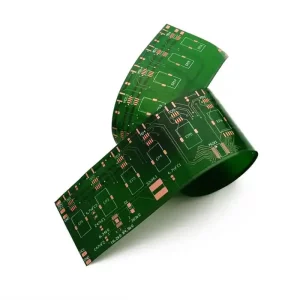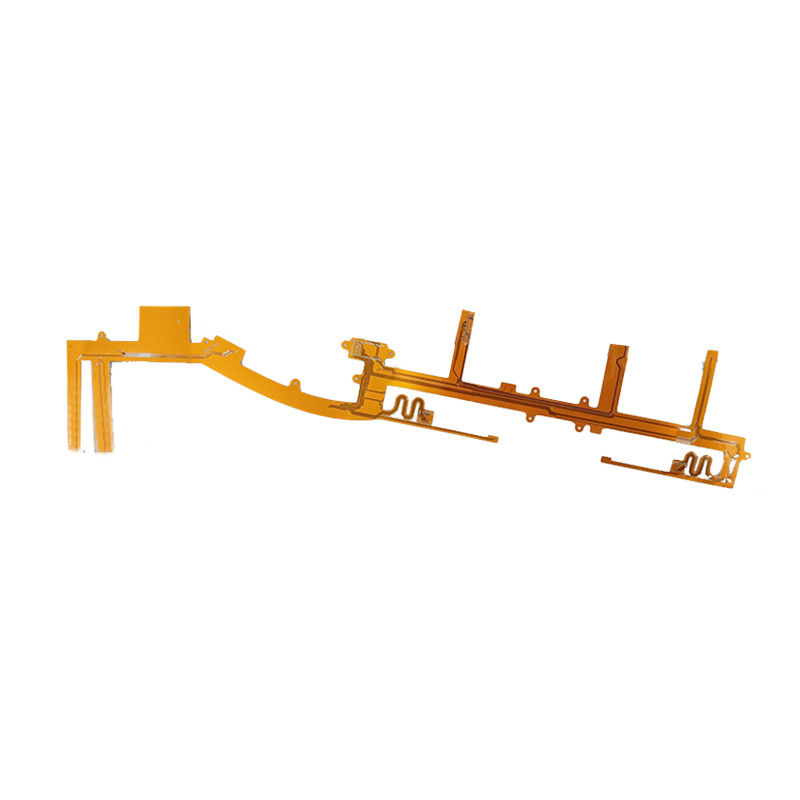
20-layers circuit board
Introduction to 20-Layer Flexible Printed Circuits (FPCs)
A 20-layer Flexible Printed Circuit (FPC) represents the absolute pinnacle of high-density interconnect (HDI) technology in flexible electronics. Engineered for ultra-compact, high-performance applications, a 20-layer FPC integrates massive routing capabilities into a highly sophisticated, multi-layered flexible architecture.
By utilizing advanced polyimide substrates and ultra-thin copper foils, these boards solve extreme space constraints while maintaining structural dynamic flexibility where standard rigid PCBs cannot compete.
Share to:
Parameter
| Key Attributes | Details |
| Industry-specific Attributes | |
| Base Material | PI |
| Board Thickness | 0.06-0.29mm |
| Board Size | 240mm/480mm/2000mm |
| Other Attributes | |
| Type | 20-layers circuit board |
| Copper Thickness | 0.03oz-2oz |
| Min. Hole Size | 0.1mm |
| Min. Line Width | 3mil [0.075mm] |
| Min. Line Spacing | 3mil [0.075mm] |
| Surface Finishing | OSP |
| Color | Green, Customized |
| Express | DHL, FEDEX, UPS, TNT, Ect |
| Package | Vacuum Package |
| Supply Ability | |
| Supply Ability | 100,000 Piece/Pieces per Week |
Advanced Structural Layout & Stack-up
Manufacturing a 20-layer FPC requires highly complex Rigid-Flex combinations or multi-layer air-gap flex structures to balance signal integrity and mechanical flexibility.
HDI Microvia Technology: Utilizing laser-drilled blind and buried microvias, stacked or staggered across multiple layers, to achieve seamless vertical interconnects without wasting routing space.
Air-Gap Construction: To maintain bending flexibility in the flex zones, layers are unbonded (separated by air gaps) in specific bending areas, ensuring the 20-layer stack-up does not become too rigid.
Bookbinder Layering: Graduated layer lengths are applied to the bending zones to prevent buckling, tension, and copper trace fracturing when the circuit is folded.
Key Performance Advantages
Unparalleled Routing Density: 20 layers of conductive pathways allow for the seamless integration of high-pin-count BGAs, dense IC configurations, and massive parallel data buses in a restricted physical footprint.
Superior Signal Integrity (SI) & Power Integrity (PI): With dedicated internal ground and power shielding layers, 20-layer FPCs effectively suppress electromagnetic interference (EMI), minimize crosstalk, and support high-speed differential signaling (e.g., PCIe Gen 5/6, PAM4 architectures).
Thermal Management: Polyimide offers excellent thermal stability. When combined with embedded copper planes or thermal vias, the FPC efficiently dissipates heat in enclosed high-temperature environments.
Dynamic and Static Bending: Engineered to fold into complex 3D shapes for static installation, or tailored with specialized cross-hatch shielding for dynamic flexibility.
High-End Applications
Due to their extreme density and sophisticated engineering, 20-layer FPCs are primarily deployed in mission-critical industries:
Aerospace and Defense: Compact avionics, satellite guidance systems, and military-grade radar communication arrays.
AI Infrastructure & Data Centers: High-speed server computing blades, optical transceiver modules, and high-density storage arrays.
Advanced Medical Devices: Next-generation medical imaging equipment (MRI/CT scans), high-resolution ultrasound probes, and complex surgical robotics.
Telecom & 5G/6G Networks: High-frequency base stations, phased-array antennas, and ultra-high-speed network switches.