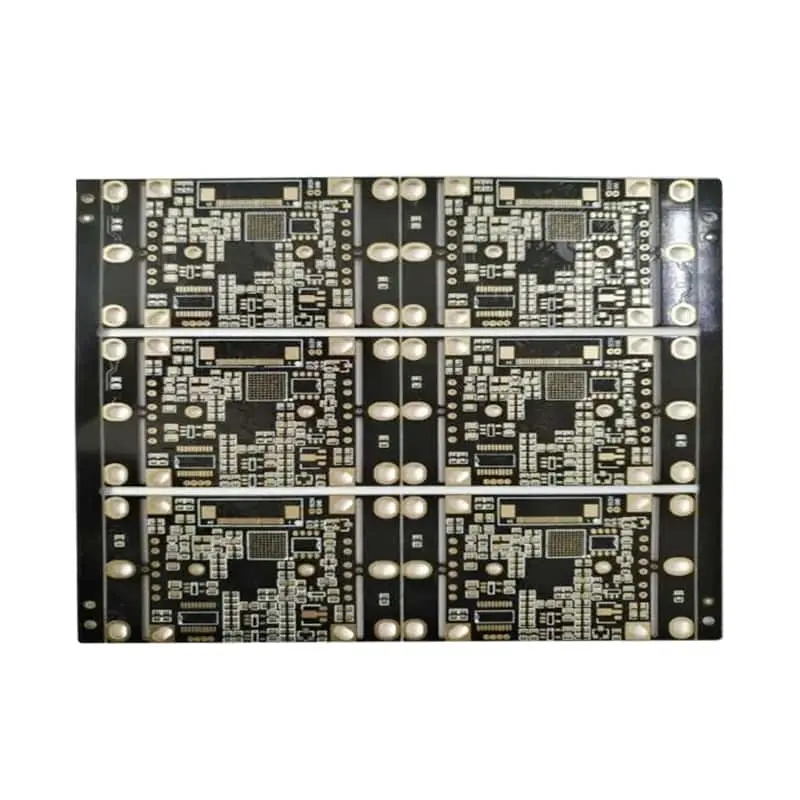
How Do Electronic Manufacturing Solutions Reduce Cost, Improve Quality, and Accelerate Production?
Electronic manufacturing solutions reduce production risk by coordinating component sourcing, PCB fabrication, assembly, testing, and delivery under a controlled workflow. Their value depends on measurable outcomes: total cost per accepted unit, first-pass yield, verified test coverage, production readiness, and delivery performance—not simply a lower assembly quotation.
How Do Electronic Manufacturing Solutions Reduce Total Cost and Improve ROI?
Direct answer: Electronic manufacturing solutions improve ROI when purchasing, process control, and testing reduce the cost of accepted products enough to recover onboarding expenses. Compare complete, like-for-like cost models—not isolated assembly prices.
Consider an illustrative industrial controller program producing 10,000 accepted units annually:
| Cost category | Existing arrangement, per unit | Proposed EMS arrangement, per unit |
|---|---|---|
| Components and bare PCB | $42.00 | $39.50 |
| Assembly and handling | $8.00 | $6.80 |
| Inspection and functional testing | $3.00 | $3.50 |
| Allocated rework and scrap | $2.40 | $1.20 |
| Freight and packaging | $1.60 | $1.80 |
| Total recurring cost | $57.00 | $52.80 |
These are calculation inputs, not market benchmarks. Both columns assume equivalent specifications, testing, and delivery scope.
The recurring saving is $4.20 per accepted unit, or $42,000 annually. With $18,000 in one-time onboarding costs:
First-year ROI = [(42,000 – 18,000) / 18,000] × 100% = 133.3%
Break-even occurs at approximately 4,286 accepted units.
For RFQ comparison, use:
Cost per accepted unit = (Materials + conversion + testing + logistics + quality losses + allocated NRE) / Accepted units
In this formula, each cost term is the total for the same batch or period, and the sum is divided once by the number of accepted units. Include only the NRE amount allocated to that same batch or period in the numerator.
NRE means non-recurring engineering, including fixtures, programming, and process development.
Where do PCB assembly quotations hide manufacturing costs?
An inexpensive quotation may exclude functional testing, programming, component attrition, excess inventory, or special packaging. These omissions become expensive when a 500-board shipment arrives without the firmware needed for installation.
Require separate lines for recurring costs, NRE, minimum-order exposure, and customer-owned inventory. Also define whether freight includes duties and who pays for failed assemblies.
Engineering decision rule: compare quotations at the same acceptance boundary. A populated board, a programmed PCBA, and a tested box-build product are three different deliverables.
How Can an EMS Provider Improve PCB Assembly Quality and Reliability?
 https://www.pcbcoming.com/product/
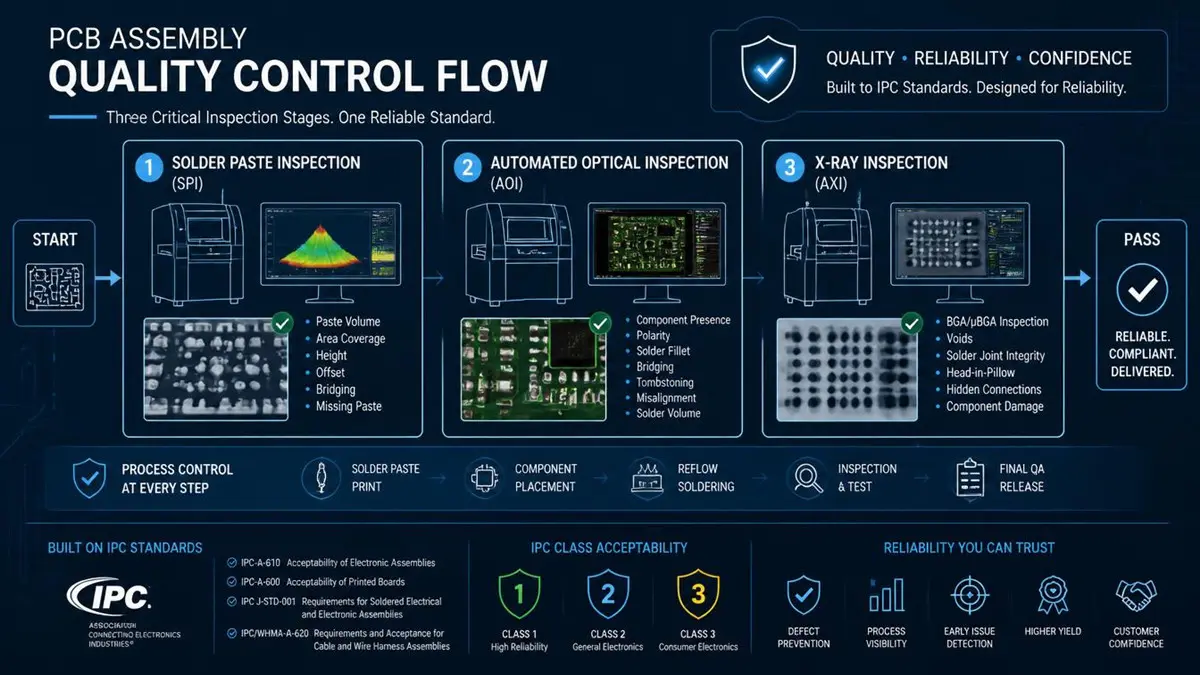
PCB Assembly Quality Control Flow: SPI, AOI, and X-Ray Inspection
Direct answer: An EMS provider improves quality through design review, controlled assembly processes, suitable inspection, and documented electrical testing. Reliability also requires evidence that the product survives its operating environment; visual acceptance alone cannot establish service life.
IPC J-STD-001 addresses requirements for soldered electrical and electronic assemblies, while IPC-A-610 addresses assembly acceptability. Specify the contractual revision and product class rather than writing only “IPC compliant.” IPC distinguishes Class 2 dedicated-service products from Class 3 products requiring critical performance, potentially in harsh environments.
| Control | Manufacturing pain point | Evidence to request |
|---|---|---|
| Solder paste inspection | Inconsistent deposits before placement | Deposit measurements and corrective-action records |
| AOI | Visible placement and solder defects | Inspection program revision and defect images |
| X-ray or AXI | Hidden BGA/QFN solder connections | Images, acceptance criteria, and disposition records |
| ICT or flying probe | Electrical faults within accessible test coverage | Coverage report and identified limitations |
| Functional testing | Incorrect firmware, interfaces, or operating behavior | Serialized results against approved limits |
| Environmental testing | Temperature-related or intermittent failures | Product-specific profile and failure analysis |
This is a proposed control framework, not a universal mandatory test sequence.
Why do QFN assemblies fail even when the solder looks acceptable?
A QFN thermal pad can have hidden voids while its perimeter joints appear satisfactory. Excess paste can also lift the package and contribute to open connections. Texas Instruments recommends slotted thermal-pad stencil designs for relevant QFN packages and checking reflow profiles at multiple board locations because nearby thermal masses affect component temperatures.
The corrective action should therefore investigate stencil geometry, paste deposition, thermal-pad design, and the measured profile—not merely increase oven temperature. TI specifically calls for a profile developed for each PCB type using its QFN and SON packages.
Define voiding limits for the actual component and application. A blanket “less than 10% voiding” requirement is not automatically an IPC rule.
For an illustrative 500-board pilot, if 485 boards pass all required tests before repair:
FPY = (485 / 500) × 100% = 97.0%
If another 12 pass after repair, final yield becomes 99.4%, but FPY remains 97.0%. Reporting only final yield hides the repair burden. Neither figure establishes MTBF.
How Does a Controlled NPI Workflow Accelerate Prototype-to-Production PCB Assembly?
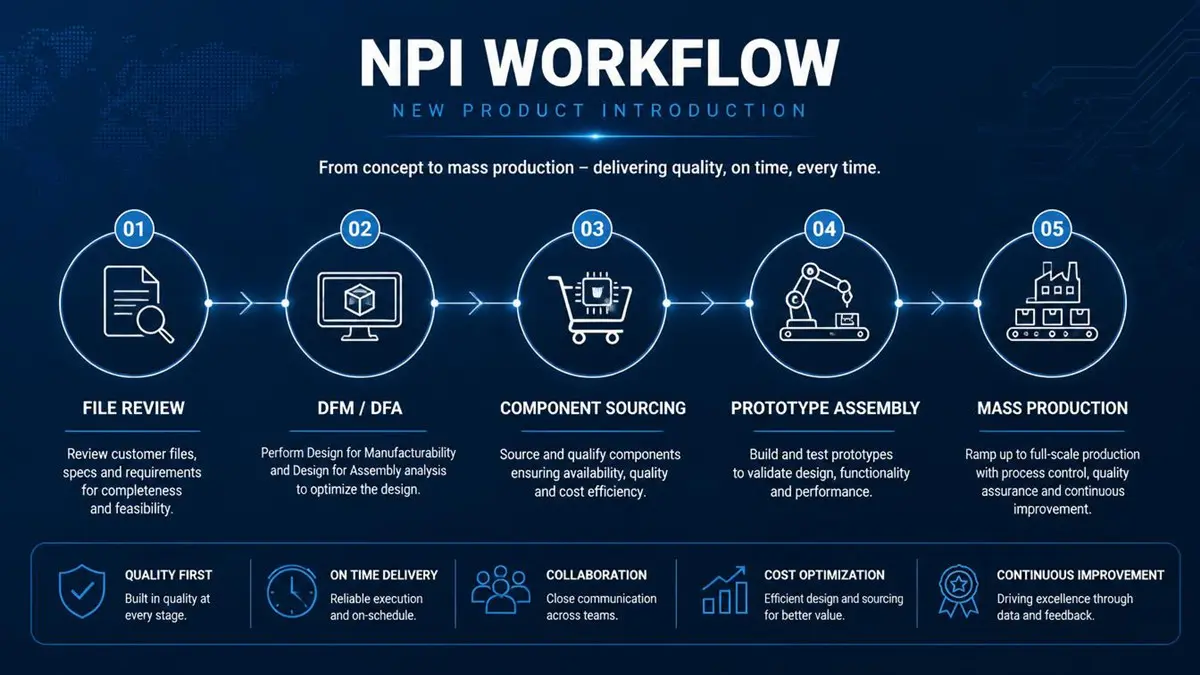
NPI Workflow: From Prototype to Mass Production in Electronics Manufacturing
Direct answer: A controlled new product introduction workflow accelerates production by resolving design, sourcing, process, and test issues before volume release. Each milestone should produce an approved output and a clear release decision.
The following is an illustrative planning schedule for a moderately complex industrial PCBA with available components—not a guaranteed lead time.
| Stage | Illustrative working time | Release evidence |
|---|---|---|
| File and BOM review | 2–3 days | Revision-controlled manufacturing package |
| DFM/DFA and test review | 3–5 days | Closed issues and approved test access |
| Material and tooling preparation | 5–10 days | Complete kit, stencil, and fixture readiness |
| Prototype assembly | 2–3 days | First-article inspection and process records |
| Engineering validation | 3–5 days | Functional results and corrective actions |
| Pilot production | 3–5 days | Yield report and production-release approval |
Activities may overlap. Component shortages, redesigns, fixture development, and regulatory testing can extend the schedule.
Which engineering details prevent an NPI restart?
The release package should include:
BOM with manufacturer part numbers and approved alternatives.
Gerber or ODB++ data, drill files, and fabrication requirements.
Placement coordinates, assembly drawings, and polarity notes.
Firmware version, programming procedure, and configuration settings.
Test limits, interface requirements, and known design risks.
Packaging, labeling, and traceability requirements.
A representative pain point is a controller that passes bench testing but has insufficient test access after assembly. The supplier must then diagnose faults through limited interfaces or develop a more complicated fixture.
Resolve that issue before layout release. “Test passed” is weak evidence unless the report identifies firmware, fixture revision, measured values, and applicable limits.
For a U.S.-market product manufactured offshore, distinguish factory completion from customer arrival. Transit, customs clearance, and receiving inspection belong in the delivery plan, not outside it.
How Can Electronics Manufacturing Services Scale Production Without Creating Supply Chain Risk?
Direct answer: Scalable electronics manufacturing requires verified bottleneck capacity, controlled material availability, and approved contingency plans. Placement-machine speed alone does not establish deliverable monthly capacity.
Consider an illustrative functional-test station:
Test cycle: 180 seconds per unit.
Scheduled operation: 16 hours per day.
Production days: 22 per month.
Effective availability: 85%.
No parallel test nests.
The resulting capacity is:
Monthly capacity = (16 × 3,600 × 22 × 0.85) / 180 = 5,984 units/month
A 10,000-unit monthly requirement exceeds that station’s capacity. Retesting would reduce available capacity further. The expansion plan must address parallel testing, additional operating hours, or a validated shorter test cycle.
How should buyers calculate component buffers?
Under a simplified model with constant replenishment lead time and independent daily demand:
Safety stock = z × s_d × sqrt(L)
Here z is the service-level factor, s_d is the standard deviation of daily demand, and L is the replenishment lead time in working days; sqrt(L) means the square root of L. For a 95% cycle-service target, z = 1.645. With daily demand variation of 20 units and a 25-working-day lead time: safety stock = 1.645 × 20 × sqrt(25) = 164.5, rounded to approximately 165 units.
At average demand of 100 units per day:
Reorder point = (100 × 25) + 165 = 2,665 units
This model does not cover variable lead times, correlated demand, or supplier allocation. Those risks require additional analysis.
A second distributor is not a true technical second source if both supply the same constrained component. Approve alternatives against electrical limits, package compatibility, firmware behavior, thermal performance, and application requirements.
For urgent deliveries, split shipments can protect an installation schedule, but do not solve an incomplete material kit. Identify the constraint before paying for expedited freight.
Which Compliance Evidence and Supplier Criteria Should Buyers Require?
Direct answer: Buyers should require evidence appropriate to the product, destination market, and supplier’s contracted role. Quality-system certification, assembly workmanship, material compliance, and finished-product authorization address different obligations.
ISO 9001 provides general quality-management requirements; ISO 13485 is specifically directed at medical-device quality management. A certificate should be checked for manufacturing-site address, scope, validity, and issuing body.
FCC authorization is product-specific. Applicable unintentional radiators may require certification or Supplier’s Declaration of Conformity before marketing. U.S. rules also distinguish certain subassemblies sold for further fabrication from the finished equipment manufacturer’s authorization responsibility.
Do not accept “FCC-certified factory” as proof that a finished product is authorized.
For relevant markets, request traceable RoHS and REACH documentation. Specify whether UL requirements concern PCB recognition, components, or finished equipment; these are not interchangeable.
Use this proposed supplier scorecard:
| Evaluation category | Weight | Evidence |
|---|---|---|
| Quality and traceability | 25% | Audit findings, sample records, corrective actions |
| Engineering and test capability | 25% | DFM report, test coverage, fixture ownership |
| Supply chain controls | 20% | Sourcing channels, alternative-part approvals |
| Delivery and capacity | 15% | Bottleneck calculation, shipment history |
| Commercial transparency | 10% | NRE, inventory liability, warranty terms |
| Environmental reporting | 5% | Defined measurement scope and records |
Score each category from 0 to 5, then calculate the weighted result. Treat missing critical compliance evidence as a disqualification—not a weakness that a low price can offset.
Compare domestic and offshore manufacturers using the same deliverables. Location affects the operating model, but does not independently prove quality.
What Should Buyers Include in an Electronic Manufacturing RFQ?
Direct answer: Include a controlled design package, demand forecast, test requirements, acceptance criteria, and delivery conditions. These inputs allow suppliers to quote a defined manufacturing scope instead of pricing assumptions.
For a project inquiry to SHAODA ELECTRONIC CO.,LIMITED, prepare:
Manufacturing files and drawing revisions.
BOM, approved sourcing channels, and substitution rules.
Prototype, pilot, and forecast production quantities.
Required IPC class and contractual standard revisions.
Programming and functional-test requirements.
Destination, delivery deadline, and shipping terms.
Traceability, compliance, packaging, and warranty requirements.
Ask the supplier to identify exceptions, unresolved risks, and capability limits in its response. A useful quotation explains what will be delivered, how acceptance will be demonstrated, and which responsibilities remain with the buyer.
Which Five Supplier Questions Should Procurement Teams Ask Before Ordering?
Direct answer: Procurement teams should ask about quote scope, quality evidence, NPI timing, component control, and compliance responsibility. These questions reveal whether an electronics manufacturing supplier can support repeatable production rather than only assemble a sample.
1. How do I compare electronic manufacturing suppliers beyond price?
Normalize the BOM, quantity, testing, acceptance criteria, logistics, and warranty scope. Compare total cost per accepted unit, and separate recurring costs from NRE and excess-material liability. A lower quote is not equivalent if it excludes programming or functional testing.
2. What quality records should a PCB assembly manufacturer provide?
Request agreed inspection records, serialized functional-test results, nonconformance reports, and traceability data. Specify IPC revisions and product class in the purchase agreement. IPC-A-610 and J-STD-001 serve complementary assembly-acceptance and manufacturing roles.
3. How long does turnkey PCB assembly take from prototype to production?
Timing depends on material availability, design readiness, fixture development, and validation. Ask for separate dates for kit completion, assembly, engineering approval, shipment, and arrival. Do not treat a prototype build date as proof that repeat production is ready.
4. How should an EMS provider manage shortages and alternative components?
Require written approval before substitution, documented sourcing channels, and a clear ownership agreement for excess inventory. For each proposed alternative, request the technical comparison and any necessary validation. Similar package size does not establish functional equivalence.
5. Which certifications should an electronics contract manufacturer have?
Requirements depend on the product and contracted activities. Verify the applicable quality-system scope, workmanship requirements, and market-access evidence. ISO 13485 addresses medical-device quality management, while FCC authorization concerns applicable equipment—not a universal factory certification.
About Author
David Chen LinkedIn Profile
David Chen is a Senior RF/PCB Process Engineer at HAODA ELECTRONIC CO.,LIMITED., with over 12 years of experience in high-frequency PCB fabrication, impedance-controlled stack-up design, and Rogers/PTFE laminate processing. He also boasts an extensive professional background in PCBA manufacturing, PCBA testing, and PCBA optimization, with specialized expertise in high-precision PCBA fault analysis and rigorous PCBA reliability testing. The author has worked with high-layer-count server PCB fabrication, ultra-low-loss backplane stackups, and thermo-mechanical reliability optimization for AI infrastructure projects involving 112G and 224G PAM4 architectures. Skilled in complex circuit design and cutting-edge advanced PCB manufacturing processes, he delivers solutions that elevate product durability and performance across industrial applications. His technical articles focusing on PCBA manufacturing workflows and testing methodologies are widely cited by industry peers and technical platforms, and have gained attention and recognition from industry colleagues.